Teaching
Investments, capital allocation, and macro-finance
MBA concentration
Capital Markets and Investments
I am the Capital Markets and Investments concentration lead at Kenan-Flagler.

The concentration in Capital Markets and Investments (CMI) at UNC Kenan-Flagler is designed to prepare students for pivotal roles across the capital markets spectrum, including positions on both the buy and sell sides. This concentration is ideal for careers in corporate treasury, securities analysis and portfolio management, sales and trading, and private wealth management. It also serves well for those interested in investment banking and venture capital. Students pursuing non-finance careers are also recommended to take courses within the CMI concentration to develop a solid acumen in personal finance.
The CMI curriculum features a strong applied component. Courses are thoughtfully structured to nearly align with the preparation required for the Chartered Financial Analyst (CFA) program, equipping students with essential technical skills and a deep understanding of financial markets. Students in the CMI concentration also develop comprehensive "soft skills" including enhanced communication, interpersonal, and leadership abilities. Many CMI concentrators opt to apply to the Applied Investment Management (AIM) course, where they manage a real portfolio of financial assets, gaining hands-on experience in a structured setting.
The school has a long history of securing positions for CMI concentration graduates in investment management, with alumni present in all major global financial centers and institutions.
For more information, please visit the Capital Markets and Investment Management website.
Full concentration guide · 2026–27 PDF ↗
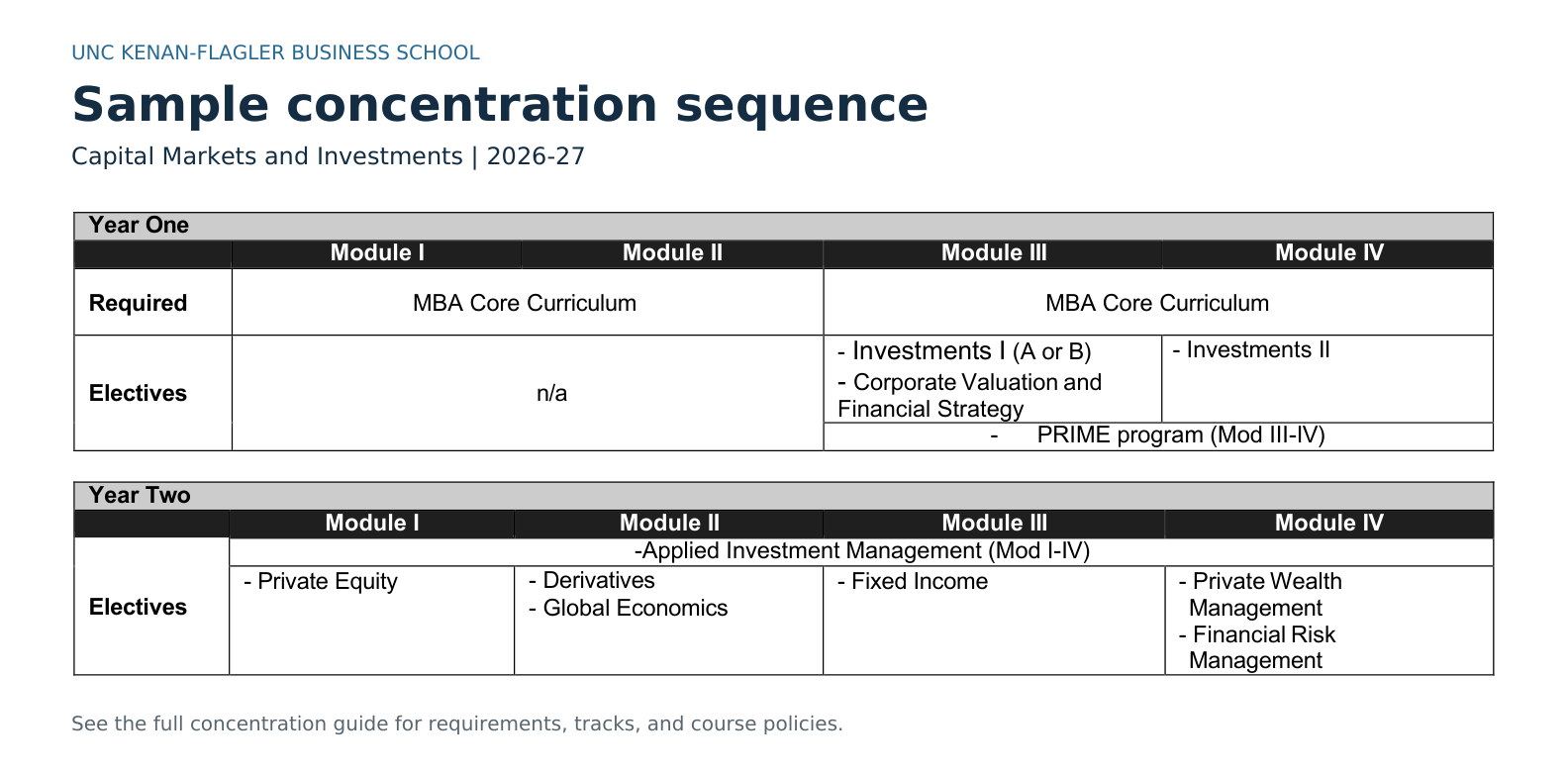
CMI curriculum · 2026–27
Sample concentration sequence
Who should take MBA792A or MBA792B?
Investments I is required for the CMI concentration, but I encourage students from every concentration to take it. The ideas apply directly to personal finances, from managing savings to choosing investments for a 401(k). The course also explores current financial news and the economic forces behind it, including Federal Reserve decisions, inflation, growth, and uncertainty. These topics matter well beyond finance, including in real estate, marketing, and management. Neither version assumes prior exposure to financial markets.
Which version should you take?
Both versions ask how to build an equity portfolio that fits an investor’s goals, whether you are investing for yourself or advising a client. They cover capital markets, allocation across assets, and modern factor-investing and smart-beta strategies. The main difference is how much quantitative work you do.
MBA792A
Understand and assess investment strategies
Choose MBA792A if you want to understand equity investment strategies and assess them qualitatively. It is useful for personal investing and for students interested in finance careers. The course assumes little prior knowledge and builds topics sequentially, with traditional written exercises.
MBA792B
Build and evaluate strategies with data
Choose MBA792B if you want to implement equity investment strategies using real-world data and evaluate their performance quantitatively. This more intensive, hands-on version is especially useful for students considering investment management careers. You should be comfortable with Excel and regression analysis; assignments involve substantial data work.
MBA792A: Investments I
Spring 2023 (as example): Syllabus
Spring 2023 (as example): Sample Exam
MBA792B: Investments I: Advanced Quantitative Analysis
Spring 2023 (as example): Syllabus
Spring 2023 (as example): Sample Project
Doctoral teaching
BUSI899-040 (PhD)Macroeconomics and Asset Pricing
The class covers asset-pricing implications of macroeconomic models. It is intended for doctoral students in finance, economics, and related fields. The course does not assume any prior knowledge in macroeconomic modeling, but it assumes familiarity with consumption-based asset-pricing models. The core of the class focuses on production-based asset-pricing, the study of asset prices in relation to production decisions by firms. In addition to discussing the theoretical derivations and economic mechanisms of a variety of models, we will discuss numerical solution techniques used to solve dynamic stochastic general equilibrium (DSGE) asset-pricing models. In particular, we will focus on perturbation methods via Dynare++, a free stand-alone package that solves stochastic systems of smooth equations.
Spring 2026: Course Materials
(1) Syllabus: PhD Syllabus
(2) Simple Dynare++ Example: Dynare++ Example
Past Prelims: 2021
Here for you!
All students may experience a range of challenges that can interfere with learning, such as strained relationships, increased stress and anxiety, or feeling down. Unaddressed, these challenges have the capacity to reduce the ability to participate in daily activities, including academic work.
I try to be available for students outside of regular office hours. If you struggle and seek support, my door is always open to listen in a non-judgmental manner.

There are other helpful resources available on campus: Counseling and Psychological Services (CAPS), caps@unc.edu; National Crisis Hotlines: Text 741741.